
Surely some revelation is at hand
– Yeats, “The Second Coming”
Question: why is “Post-Apocalytpic” a bona fide genre while the Apocalyptic itself is a sub-subgenre at best? In film, this might have something to do with production costs, since it’s a lot easier to plop a camera down near a desert highway and call it the After-End Times than hire some army of digital effects artists to illustrate a convincing End. But that wouldn’t explain why the same is true of literature, where the Post-Apocalyptic genre dominates, especially in Young Adult fiction. Likely as not it has to do with narrative possibility. A Post-Apocalypse is tabula rasa, constrained only by the creator’s imagination. A new society can look like a shabbier version of the old order, serve as an allegory for the present, or strike out in entirely new directions, often dystopic. The Apocalypse, however, propels us in one direction alone: the End. This constrains narrative space, such that nearly all of our movie Apocalypses (excepting the Now) are either disaster films or depressingly literal renderings of Biblical eschatology. Will the hero survive climate change or drown in the rising ocean waters? Will the heroine be raptured or marked by the Beast? These are narrow questions, narrowly resolved. The End-Times dread of Bergman’s Seventh Seal isn’t often replicated.
Werckmeister Harmonies is an Apocalyptic film, maybe the most unsettling ever made, and its sense of impending doom is relentless and inescapable. Béla Tarr’s apocalypse, adapted from Lázsló Krasznahorkai’s novel The Melancholy of Resistance, replicates the mounting dread of the End within a narrow, almost hermetically sealed context, an industrial town in late Communist-era Hungary, a community that seems so tightly sealed from the outside world that it might as well exist inside an especially grim snow globe. (The black-and-white photography belies the fact that, even if the film were shot in color, the dominant palate would still be grey.) The apocalypse is coming, but there is no sudden ecological disaster here, no religious ecstasy. Yet the sense that the End is Near begins at a slow creep from its opening shot, an unbroken, 10-minute sequence beginning at a furnace and ending with a bar’s drunk patrons spinning around in imitation of a cosmos before being ejected into the night. Even the movie’s cosmology is shabby and inebriated.

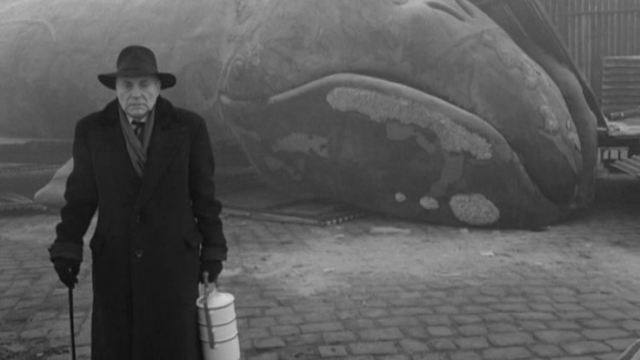
Into this closed world, a circus somehow arrives. No one knows where they come from, but whispered rumors suggest that they leave violent disorder in every town they visit. Even the word “circus” seems like an ill fit: their only “attractions” are a dead whale and a mysterious and unseen (by the camera) “Prince” who spends his evenings shouting provocations into the city square. Over the course of the film’s languid two hours, that square will slowly fill with more and more people, mostly men who seem like they aren’t from here, men with angry faces and clenched fists, huddling together and grumbling and casting threatening looks at passersby, and it feels like only a matter of time before this pressure cooker explodes.
In the meantime, we focus in on a small group of characters, led by local oddball János (Lars Rudolph). János is an eccentric but curious little rodent of a man, something of the village idiot, but ultimately kind-hearted, as he runs errands for various people across town. Among his frequent stops is the home of curmudgeonly composer György Eszter (Peter Fitz), who lives separated from his wife Tünde (Hanna Schygulla), a political and social climber intent on public improvement. Adding to the film’s irrealism: all three leads are German actors, and the Hungarian dialogue is dubbed over them.
It’s Eszter’s philosophical ruminations that provide us with the movie’s title, which is based on an acoustic paradox. If you haven’t taken any music appreciation/theory, you may take the fact that Western music uses a series of twelve “evenly” divided tones for granted, but our tunings are both historically contextual and not universally accepted. What we may expect from a piano — that its tones are “evenly” spaced and its intervals equally sonorous — turns out to be mathematically impossible. The 17th-century theorist Andreas Werckmeister came up with a solution, a consistent “imperfection” that allows us to smooth over the problem by approximation. A stubborn idealist, Eszter rejects this as philosophically absurd and (literally) unnatural — that our acceptance of an imperfect system is the Original Sin of modernity, casting us from the Paradise of celestial perfection — so he re-tunes his piano to a version he considers “pure”, insisting that the harsh sounds that result are, in fact, beautiful, no matter how much pain they cause his ears. We call this a metaphor.

If there’s anything this film is widely known for (as with all of Tarr’s output), it’s the very, very long takes. There are only 39 shots in the film’s 145 minutes, the longest average shot length of his career (nearly 4 minutes!) outside of his tv adaptation of Macbeth. In some respects this mimics Krasznahorkai’s prose, which deprives us of paragraph breaks and indentations, relying on single blocks of text that average about 30-40 pages at a time. You don’t so much read Krasznahorkai as force your way through a constant sludge of prose. In that respect, Tarr’s approach often creates the opposite effect, since the long takes can feel languid and fluid (and if you thought Cuarón did impressive work with large-scale chaos in Roma, you need to see what Tarr and his literal team of cinematographers do in the climax of this movie…)
Tarr, along with his editor and co-creator Ágnes Hranitzky, also wisely eliminates the first sixty pages of Krasznahorkai’s novel, which opens with a nightmarish train ride into town: the sequence is useful for developing certain characters/caricatures, but while Krasznahorkai’s world is more immediately grotesque and satirical, Tarr’s decision to keep the entire film within the town heightens its sense of isolation. Nothing surrounds this city but the void. No one can come and save them once the violence begins. No one will absolve them during the extended hangover that follows.
“No one” means both human and supernatural here. Werckmeister’s world is a godless one, not for apophatic reasons (i.e. one that argues for religion by its absence) but one in which meaninglessness infects even religious attempts to find coherent bearings in a world teetering on collapse. If God exists in this encroaching chaos, He frankly doesn’t matter. The devil, however, is shouting nightly into the city square.
Werckmeister Harmonies still bears the detritus of religious symbolism: after all, the motivating figure here is Leviathan, albeit reduced to a grotesque parody, a dead and rotting whale. (A helluva symbol, one which Zviagintsev would borrow in its ultimately reduced form: a pile of bones.) Yet even as parody the whale cuts an unsettling figure. During the hangover, the carcass sprawls broken and rotting across the city square, an enormous sea-monster abandoned on the city cobblestones. Not for nothing does the film end with Eszter staring into its dead eyes, looking for answers, finding only emptiness.

- Our own John Bruni wrote a piece on Werckmeister Harmonies a few years ago: fittingly, as part of his Halloween Psych-Out series.
- I also recommend this interview with Tarr, describing the long (three-year!) process of making the film.
- One thing I didn’t have a chance to get into is Mihály Víg’s spare and melancholy score. Fittingly enough, the dominant part belongs to the piano.
- For better or worse, Tarr is also responsible for launching Gus van Sant’s Death trilogy: van Sant was introduced to Werckmeister shortly before beginning his work on Gerry (and even mimicked certain shots from Tarr’s films).