
You haven’t seen a truly foreign film until you’ve seen a Guy Maddin film.
— David Cronenberg
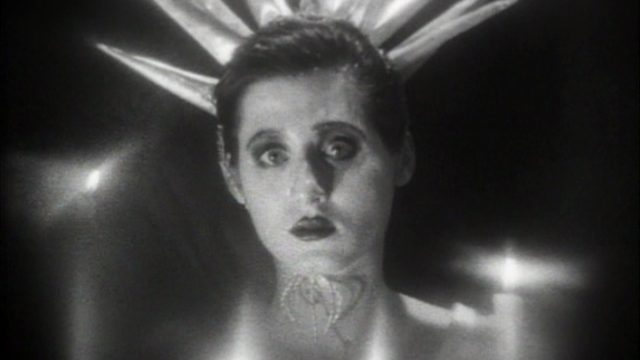
You can think of Guy Maddin’s second feature Archangel as existing not just in 1990, but in two other time periods at once. First would be 1919, when the story is set. The first World War has ended, but an international coalition is fighting the Bolsheviks on behalf of the Czar in the eponymous small, Russian town. And the second would be the late 1920s, from which this movie gets its aesthetic. Silent cinema is ending because of The Jazz Singer, but an era of part-talkie, part-silent movies is born as filmmakers adjust to this technological change. (And there’s actually a fourth time period: whenever the viewer is watching Archangel.) If this seems confusing, that’s nothing compared to the story itself.
Lt. Boles is a Canadian soldier, dazed from the war and so grief-stricken over the death of his beloved Iris that he mistakes Veronkha, a nurse with a taste for fighting in the trenches, for her, forgetting that Iris is dead. Veronkha is married to Philbin, a soldier suffering from amnesia who forgot they were married and cheated on her on their honeymoon only to later forget his infidelity and not understand why his wife avoids him. Lt. Boles is staying in a small billet, where the lady of the House Danchuk soon develops feelings for him. Eventually trauma causes Veronkha to lose her own memory, and Boles convinces her she is Iris. Boles isn’t being predatory or manipulative when he tries to implant Iris’s memories on Veronkha. He truly believes that he is helping her remember.
Not only is the story convoluted, but the style of the film is deliberately archaic, reclaiming and playing with conventions long since forgotten by most audiences. It uses jump cuts to suggest frames or entire scenes are missing. There’s occasional narration and scenes in which the dialogue is replaced by sound effects as if the audio track had been lost. The performances are as unrealistic as the obviously fake sets. As J. Hoberman put it in his review for the Village Voice: “Archangel is at once tacky and accomplished, dynamic and fusty, willfully off-putting and bizarrely romantic.”
Maddin’s inexperience as a director doesn’t hurt. He would continue to make movies with knotted, melodramatic plots but would eventually learn how to shoot and edit so that viewers could at least understand what’s going on, outrageous as it may be. “But [on Archangel] whenever I was faced with an editing decision and I could make the obvious or less-than-obvious choice, I always opted for the less-than-obvious,” Maddin admitted later.
For example, Archangel’s first scene is a rather opaque, in media res moment where Boles has Iris’s ashes confiscated and thrown into the sea by an official who mistakes them for a bottle of liquor. There’s little exposition and no dialogue. The only word on the soundtrack is Boles’ dreamy voiceover repeating “Iris…Iris….” This is followed by a tongue-in-cheek montage about the movie’s theme of “love” that soon turns into xenophobic propaganda because this is a war story as well as a love story.
For a movie that exists in at least three time periods, Archangel was also ahead of its time. Film history is filled with deliberately mysterious or artfully confusing films: Last Year at Marienbad, Persona, Eraserhead, and 3 Women all come to mind. But Archangel was released before there was an audience eager to “solve” or explain a film’s ambiguities, an audience now connected online that accepts enigmas as a sign of a film’s quality rather than a failing. It was released ten years or more before films like Memento, Mulholland Dr. (which, like Archangel, are both about memory loss), Donnie Darko and Primer, films in which figuring out what really happened is part of the experience.
It only takes a second viewing or so to understand what happens in Archangel, but there’s still something poetic and evocative about the images that can’t be explained away. “If you love me, you will find me,” Veronkha-as-Iris tells Boles. “Here are your maps,” she says as she hands him a map that will lead him successfully to her — love as the ultimate treasure hunt. Boles follows this map three times in the movie, revisiting evocative but unexplained landmarks like a soldier’s body slowly disappearing under perpetual snow, a bloody handprint (his own?) on a wall, and a machine that Archangel’s producer accurately nicknamed “The Electric Sodomizer.” The effect is similar to Mulholland Dr.: you know what is happening (Boles is looking for Veronkha as Iris) but can’t understand what the individual images mean. They hint at a significance that’s up to the viewer to decode. Each image seems to hint at its own story, half-forgotten.
In an interview about Archangel, Maddin said, “Its few adherents love the movie’s obliqueness and opacity, but if I had it to cut over again, I’d make the plot a little easier to grasp.” He got his chance with the DVD release, adding 19 intertitles that help explain the story and character motivation. It doesn’t seem like any footage was cut to accommodate these title cards, but in trying to make the narrative easier to follow, a certain poetry has been lost. The film version begins with the text, “For certain soldiers lately dead, a reverent dirge shall here be said.” The DVD version replaces this admittedly flowery intro with the more prosaic, “The Northernmost tip of old Imperial Russia. Winter of 1919. The Great War has been over for three months, but no one has remembered to tell those who remain in Archangel.” The new intertitles do make the plot easier to understand, but removing the mystery, the foreignness that David Cronenberg referred to, doesn’t improve the film at all. Worse yet, some of the new intertitles are a little too obvious and belabor the film’s absurdist humor. On the DVD, an odd scene in which everyone at the billet has trouble sleeping concludes with the intertitle “Baba is pleased that all of her loved ones are tucked in warmly. In the morning, pancakes!” The last line seems particularly tone deaf, as does Maddin’s decision to tint two of the movie’s best scenes. A sequence of soldiers in a trench being overrun by bunnies is now tinted blue and Danchuk’s cowardly husband single-handedly fighting off a group of Bolsheviks, even strangling one with his intestine after he’s been disemboweled, is now red. Both colors sacrifice visual detail and distract from the beautiful, high-contrast black-and-white imagery. Happily, when the Winnipeg Film Group raised money in 2008 to make new 35mm prints, they used the original film version rather than attempting to duplicate the DVD’s revisions.
The ending of Archangel stands apart from the rest of the film. It’s the only sequence shot outdoors, so there’s a bright, overexposed look that contrasts with the rest of the movie’s darkness-at-noon style. There’s no dialogue or explanation of what’s happening. The soundtrack features only bird sounds and an old recording of “Some of These Days.” Four stylish women see a despondent Lt. Boles and take turns kissing him, to no avail. He barely moves or acknowledges them, and the film ends on one of Maddin’s best visual puns: an iris out. According to the story, he’s actually home in Canada at a parade but the low budget and Maddin’s raw technique make this all but impossible to discern. Since I couldn’t tell what was “really” happening for years, I thought the end was either a dream or a dying vision. I found it haunting as a depiction of obsessive love and still do. Boles has lost Iris again because Veronkha’s memory has returned and she’s gone back to her husband. Surrounded by beautiful, available women, he’s so in love he might as well be dead.
What will survive of us is love.
— Philip Larkin