
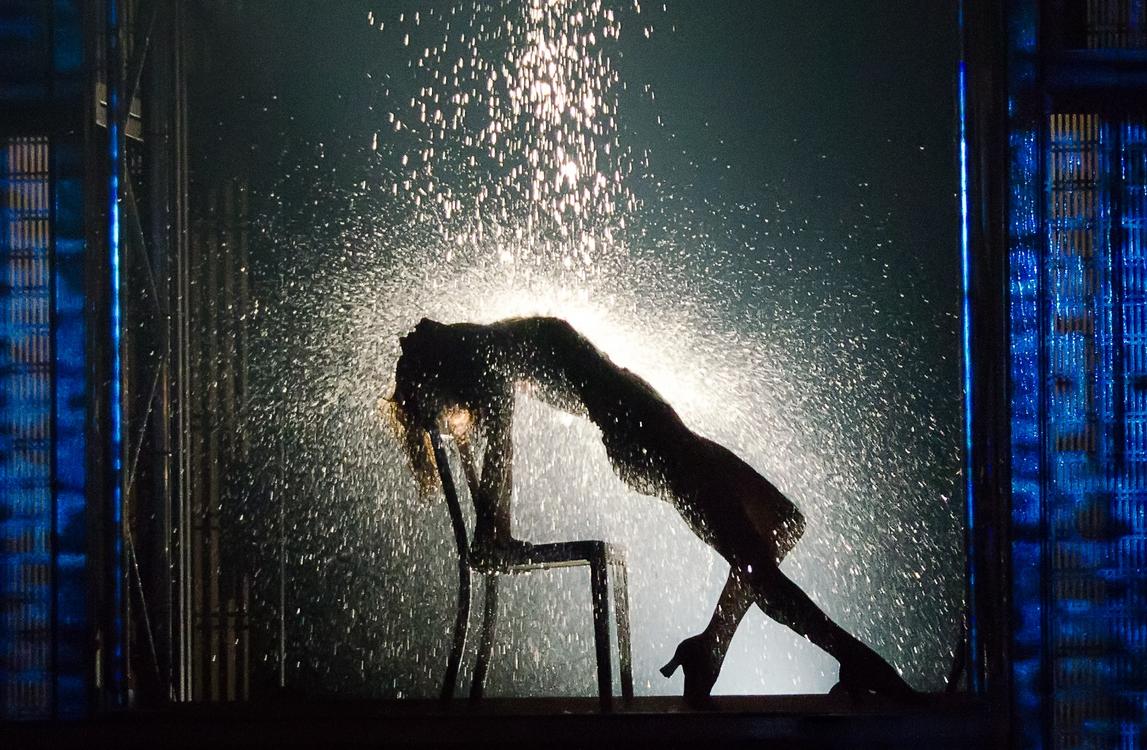
 As the method of reading against the grain was already explained in the opening of this series, we’ll begin with the infamous Hollywood artistic category of “high concept”. I have previously looked at how this idea influenced, and was reacted against by, 80s films. For example, a film like Flashdance (1983) illustrates high concept from top to bottom: a simple plot (that could be described in a few brief sentences) wedded to the flamboyant use of stylistic forms (both visually and aurally).
It’s been largely assumed, however, that high concept is a product of the end of the “last golden age of Hollywood” in the late 70s and the beginning of the hyper-commercialism (and incipient globalization) of the 80s. The best reason for this assumption: the culture during the Reagan era that promoted the greed of Wall Street has its perfect analogue in high concept films. And, sure, any academic and/or media recalling of the 80s tends to feature this type of film.
Yet it seems to me that high concept may have started much earlier. Why not say it, actually, started with Citizen Kane (1941), widely considered the greatest film ever made? I’ll tip my hand here and revisit the controversy touched off by my earlier discussion of Vertigo: the reason why Citizen Kane is not defined as a high concept film is that people like Citizen Kane in a different way than—that they think and have been encouraged to do so—they like Flashdance.
What I’m getting at is that Citizen Kane has been canonized, by both professional and non-professional critics, as high art. In the ongoing debate about taste, a critical pretense is that high art doesn’t have to make apologies for being liked, whereas low art does. That means there is a tendency for people wanting to show off their credentials to enthuse over Citizen Kane, while giving, at best, guarded praise of any film labeled as high concept—because they believe that high concept equals low art.
Thus calling Citizen Kane high concept, which owes much to Ray Carney’s interpretation, is to cross the class boundaries of taste, which has traditionally been regarded as a serious offense. But once this line has been crossed we can start to see Citizen Kane quite differently. Take, for example, the opening sequence: a “no trespassing” sign (what a symbol!), the silhouette of a mansion, a dying man’s last word (Rosebud), the shattering of a snow globe. If we’re not sure just what we’ve seen, the blare of the newsreel footage that next appears on screen announces the death of Charles Foster Kane, a newspaper man closely modeled after a pioneer of sensationalist journalism, William Randolph Hearst.
Granted the newsreel footage parodies the conventions of the time for celebrating the life of a celebrated, if controversial, figure. But it also functions as a trailer, laying out an archetypal rise and fall narrative. It’s an advertisement for itself, just like films such as Flashdance were noted for their appropriation of advertising imagery.
At the end of this footage, the problem in Citizen Kane is made clear. The story of Kane, like any account of a famous celebrity, needs a memorable ending. The decision is quickly made to find out what Kane’s last word means. This mystery is as generically familiar as it gets, yet we anticipate the payoff will be great.
It’s not just that every scene in the film naratively lines up with the newsreel; it’s that every scene has a grand stylistic flair, a hyperbolic pronouncement, that feels like an extension of the newsreel. Of course, that’s what Kane loved the most, making everything around him as big as possible to fit the way he saw himself.
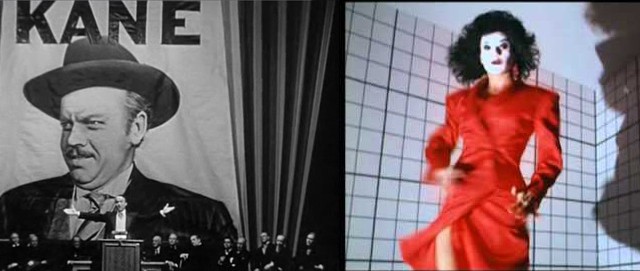
Yet it’s hard to separate Kane from the man, Orson Welles, who made him and acts his part in the film. Just as Kane directs the people around him to build his grandiose fantasy world, so does Welles. Image after dazzling image is delivered to us, courtesy of Welles’s imagination. One that stands out for me, often reproduced in film textbooks, is Kane delivering a speech with a massive backdrop of himself that overshadows him. Kane himself couldn’t come up with anything better to illustrate the power of celebrity.
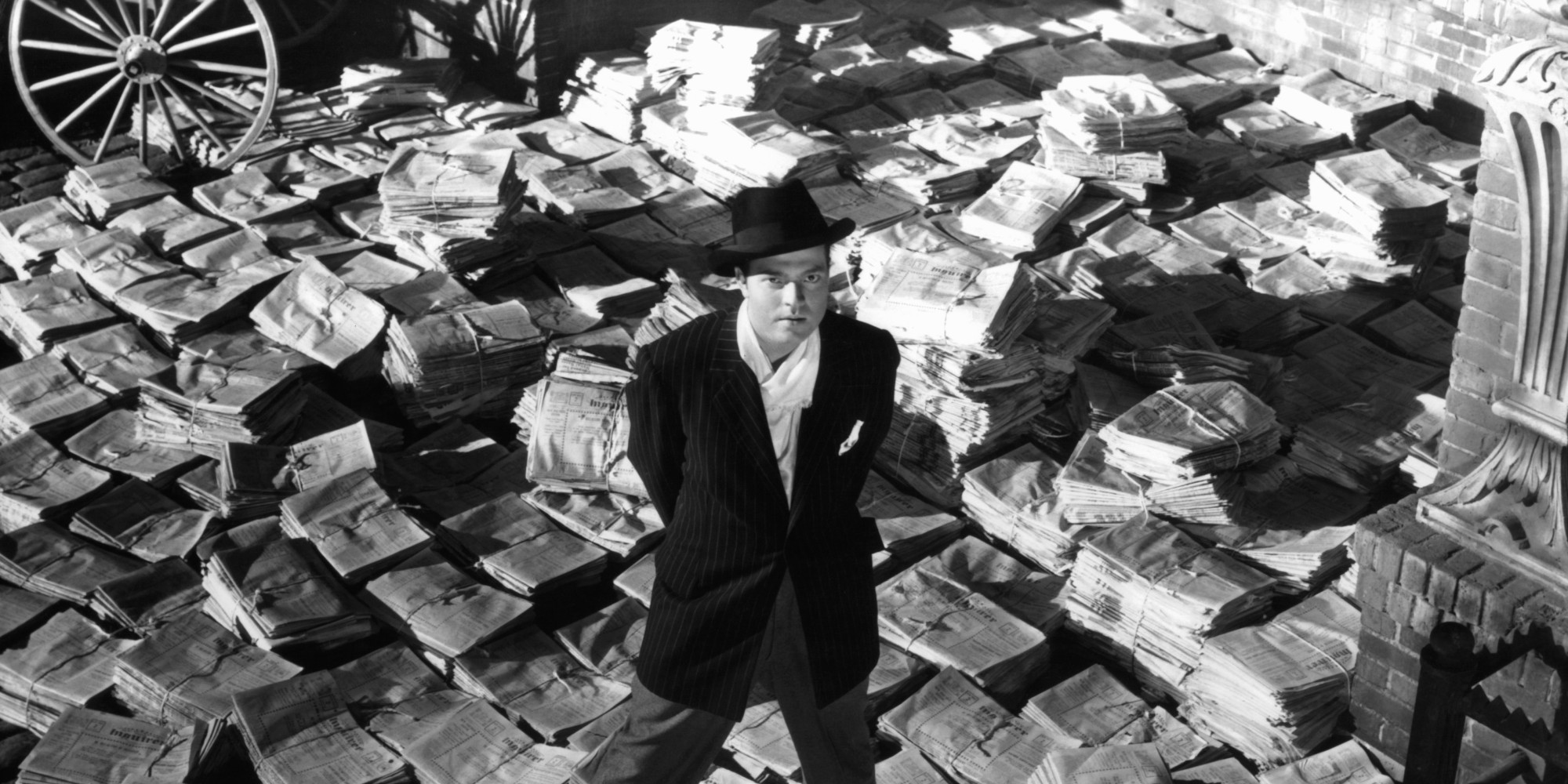
Welles makes the choice to not use images to explore emotional range but rather to use them to compress this range down to a single emotion for each image. Write down every emotion that comes to mind when envisioning the scenes of a rise and fall story and you’ll find them neatly and orderly presented.
View Citizen Kane, while keeping what I’ve been saying in mind, and you’ll notice the film is rather easy to watch. It’s perhaps more of an enjoyable experience than you might expect, because you don’t have to concentrate all that hard—the images tell you all you need to know. The dialogue reinforces the meaning of the images; every character speaks clearly, as if on the stage of a theater, and they all sound similar, each character expressing the intentions of Welles to always focus on his starring role as Kane.
Now, I trust that no one thinks I’m putting down Citizen Kane here. I’m just testing the preconceptions that Citizen Kane offers us an emotionally different experience than any 80s Hollywood blockbuster. Indeed, I’m fascinated with the way that Citizen Kane has been, if you will, retroactively marketed to generation after generation of film goers.
My argument perhaps might better come into view if Citizen Kane is compared with The Maltese Falcon, released in the same year. The Maltese Falcon is full of misdirection and indecision, from the dense and murky dialogue that often has a comic undercurrent as the tension builds to the final shattering revelation about the characters and the much sought after statue of the bird they’ve been pursuing.
The endings of the two films might seem similar. In The Maltese Falcon, the statue is not found. In Citizen Kane, the meaning of Rosebud is not discovered.
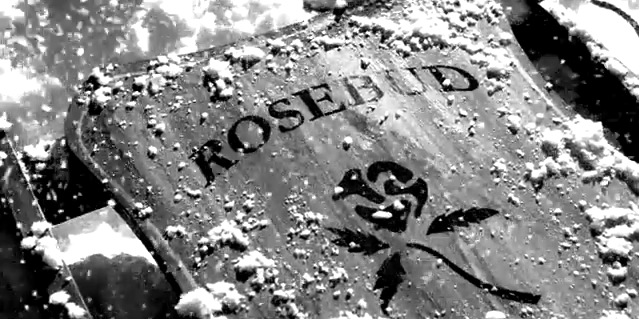 But that’s not exactly right: no one in Citizen Kane is made aware of the meaning—we, however, are when we see the final shot of a childhood sled with the name of Rosebud on it thrown into a fire by the workers hired to clean out Kane’s mansion. The irony (remember the shattered snow globe?) is unmistakable, and the film flatters us by letting us in on the secret.
It goes without saying that Citizen Kane has been highly influential. The Coen brothers, for example, routinely use the film as a template for creating stylistically inventive images and narrative irony. I would not hesitate to encourage people to regard Citizen Kane as the Rosetta Stone for studying the development of Hollywood cinema – both stylistically and conceptually.